





Introduction
When choosing a hosting plan, you will often come across two terms that appear repeatedly: Bandwidth and Data Transfer. Because hosting providers sometimes use these terms interchangeably, it can be easy to assume that they mean the same thing. However, they refer to two different concepts, much like the difference between the flow capacity of a water pipe and the total amount of water consumed from a tank over a period of time.
To make the distinction easier to understand, imagine that your website is a large store and that visitors enter through a main entrance. In this example, Bandwidth represents the capacity of that entrance — in other words, how much data can pass through it at the same time.
If the entrance is narrow or the available bandwidth is limited, congestion can occur when many visitors try to enter at the same time, even if the store itself is capable of handling thousands of visitors.
To make the analogy even clearer, think of Bandwidth as the "width of the store's main entrance." It determines how much data can pass through the connection per second without creating congestion. A wider entrance allows more visitors to enter simultaneously and reduces waiting. A narrow entrance, on the other hand, can become congested when too many visitors arrive at once, resulting in slower access.
Technically, bandwidth is not measured by the number of people passing through the entrance but by the amount of data that can be transferred per second. This is why bandwidth is measured in units such as megabits per second (Mbps) or gigabits per second (Gbps).
The higher the available bandwidth, the more data can be transferred at the same time, allowing more visitors to access website content without creating network congestion. If the available bandwidth is limited and the number of simultaneous requests increases, the connection may become congested, potentially resulting in slower page loading and delayed responses.
Data Transfer, on the other hand, is more like a total counter that records how much data has passed through the entrance over a specific period, such as an entire month. Every visitor who accesses your website consumes a certain amount of data. One visitor may load an image, another may watch a video, while another may read a long article. Every page view, download, upload, or other data exchange can contribute to the total amount of data transferred.
This data accumulates over time. Unlike bandwidth, which describes the capacity available at a given moment, Data Transfer measures the total amount of data transferred during a specific period. For this reason, data transfer is typically measured in gigabytes (GB) or terabytes (TB).
Bandwidth vs. Data Transfer: Why Are They Often Confused?
The main reason for the confusion is the way hosting companies market their services. Many providers advertise "unlimited bandwidth" when they are actually referring to unlimited or unmetered monthly data transfer.
Another source of confusion is the terminology used in different languages. In Arabic, for example, both terms are sometimes translated using the same expression, which can make it even more difficult to distinguish between them.
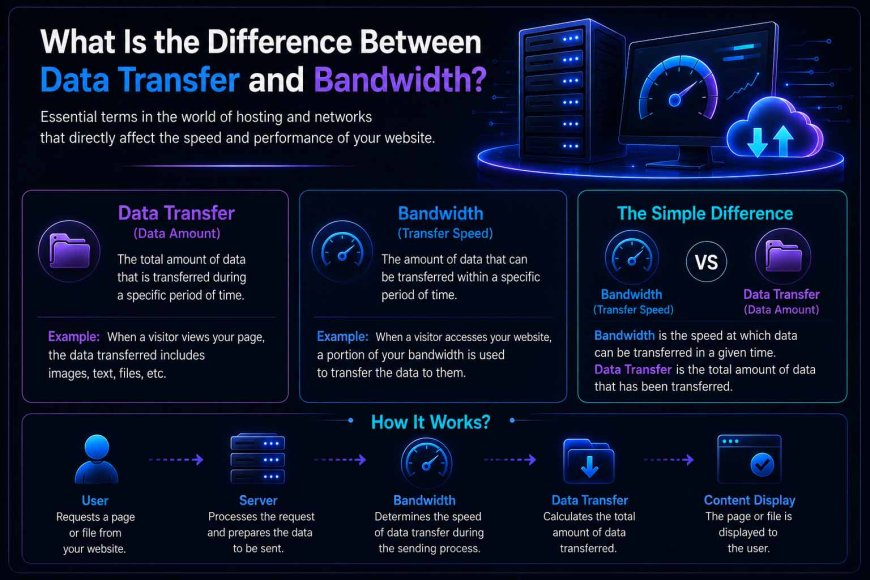
The key difference is simple: Bandwidth refers to the amount of data that can be transferred at a given time, while Data Transfer refers to the total amount of data transferred over a specific period.
Understanding this distinction can help you evaluate hosting plans more accurately and avoid unexpected limitations or additional charges.
Now that we have explained the basic difference between Bandwidth and Data Transfer, let's take a closer look at how each one works in practice. We will start with Bandwidth and examine how the available capacity affects the transfer of data between your website and its visitors.
How Does Bandwidth Work?
Bandwidth determines how much data can be transferred between the hosting server and website visitors over a given period of time. When a user opens a page on your website, their browser sends a request to the server. The server then sends the required website files, such as HTML pages, images, CSS files, and JavaScript, back to the user's device.
This process consumes part of the available bandwidth.
For example, if a webpage contains approximately 5 MB of data, loading that page transfers roughly 5 MB of data to the visitor. As the number of visitors increases, or as the size of your website's content grows, the amount of data being transferred also increases.
Website performance during periods of high traffic depends partly on whether sufficient bandwidth is available. If bandwidth is limited while many requests are being processed simultaneously, the connection may become congested. This can result in slower page loading or delayed server responses.
With sufficient bandwidth, however, the hosting server can handle a greater number of simultaneous data requests and transfer website content more efficiently.
What Happens When You Exceed Your Bandwidth Limit?
If your hosting plan has a bandwidth or traffic limit and your website exceeds it, the consequences depend on the hosting provider's policies and the type of hosting plan you are using.
Some hosting providers may temporarily suspend the website until the next billing cycle begins, while others may charge additional fees for the amount of traffic that exceeds the included limit.
In some cases, the website may remain online but experience reduced data transfer speeds or restricted access, which can significantly affect page loading times and the user experience, particularly during periods of high traffic.
For this reason, it is important to choose a hosting plan with sufficient bandwidth for your website's expected traffic and content. Monitoring your usage regularly can also help you avoid unexpected downtime, performance limitations, or additional charges.
Now that we have covered Bandwidth, how it works, and what may happen when its limits are exceeded, let's move to the other side of the equation: Data Transfer. What happens to the data when visitors browse your website and download its content, and how does this data accumulate over the course of a month?
How Does Data Transfer Work?
Data Transfer occurs whenever information moves between your website's hosting server and a user's device over the network.
When a visitor opens a page on your website, their browser requests the page's resources from the server. These resources may include HTML, CSS, JavaScript, images, fonts, videos, and other files. The server sends these files to the visitor's device, and the amount of data transferred contributes to the website's overall Data Transfer usage.
Data transfer is not limited to viewing webpages. Watching a video, downloading a PDF, uploading an image, downloading software, or accessing other website resources all involve data being transferred over the network.
As these activities are repeated by visitors, the total amount of transferred data accumulates day after day, eventually forming the website's total Data Transfer for the specified period.
Therefore, Data Transfer does not measure website speed or network capacity at a specific moment. Instead, it measures the total amount of data transferred during a specific period.
This is why many hosting plans define a monthly data transfer allowance, usually measured in gigabytes (GB) or terabytes (TB).
What Happens When You Exceed Your Data Transfer Limit?
When a hosting provider specifies a Data Transfer limit for your website, it means that your hosting account has a defined amount of data that can be transferred during a particular billing period.
If your website exceeds this limit, the consequences depend on the provider's policies and the hosting plan you have selected.
Some hosting companies may charge additional fees for the data transferred beyond the included allowance. Others may restrict the website or reduce its data transfer rate, resulting in slower loading speeds for pages and files, especially during periods of high traffic.
In some cases, a provider may temporarily suspend the website or certain services until the next billing cycle begins or until the hosting plan is upgraded.
Therefore, exceeding a Data Transfer limit does not necessarily mean that your website will immediately go offline. The outcome varies between hosting providers. Some may allow a certain amount of additional usage, send usage notifications, charge overage fees, or apply temporary restrictions.
For this reason, when choosing a hosting plan, it is important to look beyond the advertised Data Transfer allowance. Check the provider's overage policy and determine exactly what happens if your website exceeds the included limit.
Bandwidth vs. Data Transfer: What Is the Difference?
The easiest way to remember the difference is to think of Bandwidth as capacity and Data Transfer as total usage.
| Feature | Bandwidth | Data Transfer |
|---|---|---|
| Meaning | The amount of data that can be transferred at a given time | The total amount of data transferred over a specific period |
| Typically measured in | Mbps or Gbps | GB or TB |
| Main concern | How much data can be transferred simultaneously | How much data has been transferred in total |
| Impact | Can affect how many simultaneous requests can be handled efficiently | Determines how much traffic your hosting plan can accommodate over time |
| Example | 1 Gbps connection | 1 TB of monthly data transfer |
Conclusion
Understanding the difference between Bandwidth and Data Transfer is important when choosing the right hosting plan.
Bandwidth refers to the capacity or rate at which data can be transferred through a network at a given time, while Data Transfer refers to the total amount of data transferred over a specific period.
Every website has different requirements depending on factors such as the number of visitors, page and file sizes, and the type of content it provides. Therefore, choosing the right hosting plan is not simply a matter of selecting the highest bandwidth available. You should also consider the plan's Data Transfer allowance and the hosting provider's policy for exceeding that limit.
By understanding the difference between these two concepts, you can better estimate your website's hosting requirements, avoid unexpected restrictions or additional costs, and choose a hosting service that can support both your current traffic and your expected future growth.