





Introduction
When you start creating a website, you will come across several terms that may seem complicated at first, such as domain, server, and web hosting. However, understanding these concepts is much simpler than you might expect.
Let's simplify the idea with a simple example. Imagine that your website is a store. The first thing a store needs is an address so people can find it. This is exactly what a domain name represents. It is your website's address on the internet, similar to the address of a physical store. When a visitor enters this address into their browser, they are directed to your website.
Next, the store needs a physical location where it can keep its products. In the world of websites, this location is the server. A server is a computer connected to the internet that stores your website's files, such as images, videos, webpages, databases, and other resources required for the website to operate.
Web hosting, on the other hand, is a service provided by specialized companies that gives you storage space and server resources to store and run your website. To make the concept even clearer, imagine that you rent a space for your store. The company providing that space is similar to a hosting provider, while the space itself represents the server where your website's files are stored.
Therefore, when you hear the terms domain, server, and hosting, there is no need to think of them as complicated technical concepts. Simply remember:
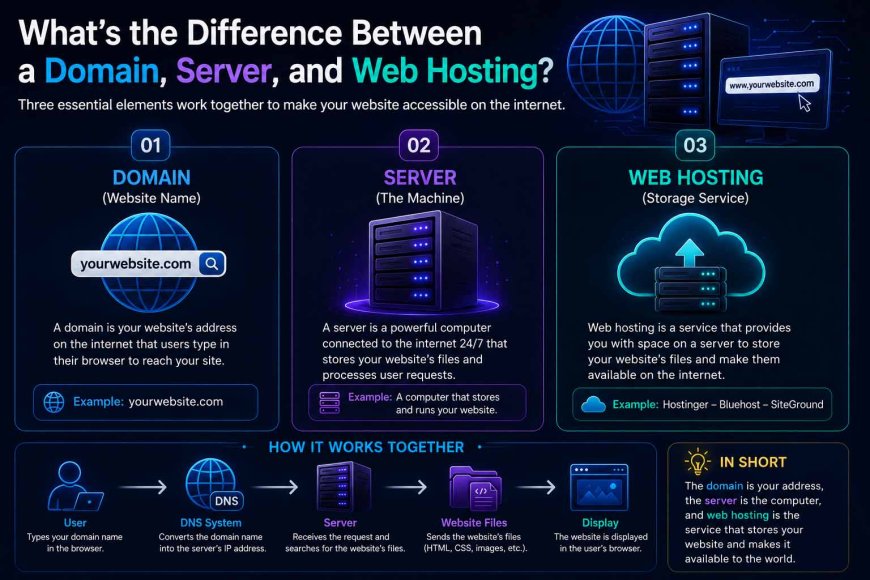
The domain is the address, the server is the place, and web hosting is the service that provides the space and resources you need to run your website.
Now that we have introduced the domain, server, and web hosting in simple terms, let's take a closer look at each one, how it works, and its role in creating and running a website.
What Is a Domain Name?
A domain name is the address visitors use to access your website on the internet. You can think of a domain name as your home's address. Just as your home needs an address so people can find it, your website needs a domain name so visitors can access it easily.
It is also important to understand the difference between a domain and web hosting, as these two concepts are often confused. The distinction is similar to the difference between your home's address and the actual building itself.
The domain is the address you give people so they can find you, while web hosting is the physical space where your website's files and content are stored. The domain directs visitors to your website, while hosting provides the environment where they can access your website's content.
How Does a Domain Name Work?
When a visitor enters your website's domain name into a browser, such as example.com, the browser needs to determine where the website is hosted before it can load the site.
This is where DNS (Domain Name System) comes in. DNS connects the domain name to the server where your website is hosted. When a visitor requests your website, DNS looks up the destination associated with the domain and directs the browser to the appropriate IP address.
The browser then connects to the server and requests the website's files. The server processes the request and sends the required files back to the browser, allowing the website to appear on the visitor's screen.
In simple terms, the domain is the name visitors use to access your website, while DNS translates that name into an IP address so the browser can connect to the server where your website's files are stored.
Why Is a Domain Name Important?
A domain name makes it easier for people to access your website and gives your online presence a clear and recognizable identity. Instead of requiring visitors to remember a long and difficult IP address, they can simply enter your domain name into their browser.
To understand why this matters, imagine that you own a great business or have an excellent idea, but you place your store in a difficult-to-reach location without a clear sign displaying your business name. No matter how good the store is, people may struggle to find it or remember where it is.
This is where the domain name becomes important. It acts as both the address and sign of your online store, helping people find your website, recognize your brand, and remember it.
A domain name can also contribute to a more professional online presence and build greater trust among visitors, particularly when the domain is closely associated with your business or brand and is easy to remember.
You can also use your domain to create a professional business email address, such as [email protected], instead of relying on generic free email services.
Another important advantage of owning a domain is that it gives your website a consistent digital address. If you decide to change your hosting provider, you can keep the same domain and point it to the new hosting service. This means you do not have to change your website's address or ask visitors to remember a new one.
Choosing an appropriate domain name can also make your website easier to remember and share. A name that is short, clear, and relevant to your business is generally easier for visitors to remember, type, and share through social media, advertising, or recommendations.
Therefore, a domain name is much more than a name entered into a browser. It is your website's online address and digital identity, helping people find your website, recognize your business, and remember it.
Now that we understand what a domain name is and why it matters, let's move on to the server, what it is, how it works, and why it is important for websites.
What Is a Server?
A server is a computer connected to the internet that stores your website's files and data, including webpages, images, videos, databases, applications, and other resources.
To make the concept easier to understand, imagine that your website is a store and the server is the physical location where the store exists and where all of its contents are kept.
Just as a physical store needs a location to keep its products and equipment, a website needs a server to store its files and data.
How Does a Server Work?
Now that we understand that a server is where your website's files and data are stored, let's look at how it works.
When a visitor enters your domain name into a browser, such as example.com, the browser needs to locate the server where the website is hosted. Once the server is identified, the browser sends a request to open the website or a specific page.
The server receives the request and looks for the required files and data, such as the webpage, images, stylesheets, scripts, and other resources.
It then sends the requested data back to the visitor's browser.
The browser processes these files, combines the different resources, and renders the website on the visitor's screen in the form they see.
Why Is a Server Important?
The server is important because it is where your website's files and data are stored. However, its role goes beyond simply storing files.
Depending on its type and configuration, a server can also run websites and applications, manage databases, process user requests, handle accounts and permissions, and provide other services.
A server can therefore be considered the backbone of a website's digital presence. It is not simply a powerful computer; it is the system responsible for storing website files, databases, and software and for processing the requests required to deliver services to users.
Now that we have covered domains and servers, including how they work and why they matter, let's move on to the final component: web hosting.
What Is Web Hosting?
Web hosting is a service provided by specialized hosting companies that gives you access to storage space and server resources on a server connected to the internet. This allows you to store your website's files and data, run your website, and make it accessible to visitors.
In simple terms, when you create a website, you need a place to store its files so that visitors can access them online. Web hosting is the service that provides this space and the resources required to operate your website.
How Does Web Hosting Work?
When you sign up for a hosting service, the hosting provider allocates storage space and server resources to your website on one of its servers.
You then upload your website's files and data to that hosting environment.
When someone visits your website, their browser connects to the server where your website's files are stored. The server processes the visitor's request and sends the required files and data back to the browser, allowing the website to load.
Simply put:
The hosting provider provides the service, while the server provides the space and resources used to run your website.
Why Is Web Hosting Important?
Web hosting is important because it provides the space, resources, and infrastructure your website needs to operate on the internet.
When you create a website, you need storage space for its files and data, as well as server resources to process requests and deliver that content to visitors. Web hosting provides these resources through the server environment where your website is hosted.
Hosting companies also typically provide more than storage space. Depending on the provider and hosting plan, they may offer services such as backups, server management, security features, technical support, monitoring, and other tools designed to help you operate and maintain your website.
As a result, web hosting provides your website with the environment, resources, and services required to keep it online and accessible to visitors.
Domain vs. Server vs. Web Hosting: What Is the Difference?
Now that we have covered domains, servers, and web hosting, we can understand how these three components work together.
| Component | What It Is | Main Purpose |
|---|---|---|
| Domain | Your website's human-readable address | Helps visitors find and access your website |
| Server | A computer or system connected to the internet | Stores website files, runs applications, and processes requests |
| Web Hosting | A service that provides server resources | Gives your website the storage, resources, and infrastructure it needs to operate |
The easiest way to remember the difference is:
The domain is the address, the server is the place where the website lives, and web hosting is the service that provides the space and resources needed to run it.
Conclusion
After understanding domains, servers, and web hosting, it becomes much easier to see how these components are connected.
The domain is your website's address on the internet, which visitors use to access it. The server is the system where your website's files and data are stored and where requests are processed. Web hosting is the service that provides the storage, server resources, and infrastructure required to run your website and make it available online.
In simple terms, you can think of it this way:
The domain is the store's address, the server is the location where the store exists, and web hosting is the service that provides the space and resources needed to operate it.
By understanding these three fundamental concepts, you now have a clearer picture of how websites work and how domains, servers, and hosting work together to make a website accessible on the internet.