





Introduction
Choosing the right web hosting service is an important step toward the success of any website, as it directly affects website speed, performance, security, and reliability. A good web hosting service helps your pages load quickly, providing visitors with a better user experience. It can also contribute to improving your website’s search engine rankings, as page speed is one of the factors search engines consider when ranking search results. This can help improve your website’s visibility and attract more visitors.
On the other hand, choosing a poor hosting service can lead to slow loading times, frequent downtime, a poor user experience, and potentially lower search engine rankings. Slow and unstable websites are generally less competitive than websites that offer fast and reliable performance.
Therefore, choosing the right web hosting provider is not simply a technical decision; it is a direct investment in the success of your website. In this guide, we will explain what web hosting is, explore the different types of web hosting, and discuss the most important factors to consider when choosing a hosting service. This will help you make the right decision and ensure that your website operates efficiently, securely, and reliably.
What Are the Different Types of Web Hosting?
Web hosting is a service that provides you with space on an internet-connected server to store your website or application files. This makes your website accessible to users at any time and from anywhere through its domain name.
To make the concept of web hosting easier to understand, you can think of it as renting a piece of land in the real world.
When you want to build a house or open a store, you first need a suitable piece of land where you can establish your project, along with an address that allows people to find and reach you. You then place your belongings or products there so visitors can access and use them.
The same principle applies in the digital world. A website or application needs a place where its files can be stored and remain accessible to visitors around the clock. This place is storage space on a powerful computer that operates continuously and is connected to the internet. This computer is known as a server.
The company that provides this storage space, operates and maintains the server, and ensures its continued availability is known as a hosting provider.
Shared Hosting
Shared hosting is a type of web hosting in which multiple websites are hosted on the same server. These websites share the server’s primary resources, including CPU, RAM, storage space, and bandwidth.
You can think of shared hosting as living in an apartment building. Each website has its own private space, but it shares the same building and its resources with other residents. Similarly, websites hosted on the same server share the server’s available resources and capabilities.
Do You Need Technical Experience for Shared Hosting?
Shared hosting does not require advanced technical knowledge. It is one of the easiest types of web hosting to manage because hosting providers typically offer user-friendly control panels that make it simple to manage websites, files, databases, and other hosting settings.
For this reason, shared hosting is a suitable option for beginners, small websites, blogs, and new projects. However, users may still need some basic technical knowledge to perform tasks such as installing applications, managing email accounts, and carrying out simple updates.
VPS Hosting
VPS hosting (Virtual Private Server hosting) is a type of web hosting that combines some of the benefits of shared hosting and dedicated hosting.
With VPS hosting, a physical server is divided into several independent virtual servers, and each website is allocated a dedicated portion of the server’s resources, such as CPU, RAM, and storage.
A VPS can be compared to a large building divided into separate apartments. Each apartment has its own private space, while some of the building’s core infrastructure is shared.
If shared hosting is like having a room in an apartment, then a Virtual Private Server (VPS) is like having your own apartment inside a residential building. You are still in a building with other residents, but you no longer share your kitchen, bathroom, or allocated resources with them. Virtualization creates a greater degree of separation between users, giving each website more control over its environment and settings than shared hosting.
VPS hosting is a suitable option for advanced eCommerce stores and websites that require greater control over server settings and software. It provides more flexibility when customizing the hosting environment and allows users to install software and configure settings according to their website’s specific requirements.
This makes VPS hosting a good choice for projects that require more resources, greater flexibility, and higher performance.
However, VPS hosting generally requires more technical knowledge to manage and maintain because users may need to configure the server, perform security updates, monitor performance, and troubleshoot technical issues.
For this reason, VPS hosting is best suited to website owners with the necessary technical skills or businesses that have a specialized technical team to manage the server effectively.
Do You Need Technical Experience for VPS Hosting?
VPS hosting requires an intermediate level of technical knowledge compared with shared hosting because it provides users with greater access and control over server settings.
Managing a VPS may require some knowledge of operating systems, software installation, security configuration, server monitoring, and resource management. Users who do not have this expertise may benefit from choosing a managed VPS hosting plan, where the hosting provider handles many of the technical tasks.
Dedicated Hosting
Dedicated hosting is a type of web hosting in which an entire physical server is dedicated to a single website or application. Unlike shared hosting, the customer does not share the server’s resources with other websites.
If shared hosting is like a room in an apartment, and VPS hosting is like a private apartment inside a building, then dedicated hosting is like owning an entire house. You have access to all of the available resources without sharing them with other users.
With dedicated hosting, the hosting provider gives you an entire server and its hardware resources, including the CPU, RAM, and storage, exclusively for your website or application.
This provides a high level of performance because the server’s resources are dedicated entirely to your website. Other websites cannot consume these resources or affect your server’s performance.
Dedicated hosting also provides extensive control over the server environment. Depending on the hosting plan and management level, you may be able to choose the operating system, install the required software and applications, and configure the server resources according to your website’s needs.
For these reasons, dedicated hosting is suitable for large websites, high-traffic eCommerce stores, major online platforms, and projects that require powerful performance, high reliability, and advanced security.
However, dedicated hosting is one of the most expensive types of web hosting. It is therefore typically used by larger companies and projects that require fully dedicated resources and greater control over their hosting environment.
Do You Need Technical Experience for Dedicated Hosting?
Yes. Dedicated hosting generally requires advanced technical knowledge to manage effectively because it provides extensive control over the server and its configuration.
Managing a dedicated server may require knowledge of operating systems, security configuration, software installation, server monitoring, troubleshooting, regular updates, and maintenance.
Businesses without the necessary technical expertise can choose managed dedicated hosting, where the hosting provider takes care of many server management and maintenance tasks.
Cloud Hosting
Cloud hosting is a type of web hosting that relies on a network of interconnected servers rather than a single physical server.
This means that your website does not depend on one server alone. Instead, its resources and data can be distributed across multiple servers that work together as a unified hosting environment. This approach provides greater flexibility, scalability, and reliability.
Cloud hosting differs from traditional hosting in how it handles server failures and sudden increases in traffic.
With traditional hosting, if the server hosting your website experiences a failure or goes offline, your website may become unavailable until the issue is resolved.
With cloud hosting, however, if one server experiences a problem or requires maintenance, workloads can be redirected to other servers within the network. This reduces the risk of downtime and helps maintain service availability.
Cloud hosting is a suitable choice for websites that require high flexibility and the ability to handle changing levels of traffic, including eCommerce stores, news websites, educational platforms, and applications experiencing continuous growth.
It is also suitable for businesses that require reliable performance and scalability, particularly during periods of increased demand or unexpected traffic spikes.
Do You Need Technical Experience for Cloud Hosting?
The level of technical knowledge required for cloud hosting depends on the type of service you choose.
Some cloud hosting plans are fully managed by the hosting provider, making them relatively easy to use without advanced technical knowledge. Other advanced cloud hosting solutions require technical expertise to manage server configurations, monitor resource usage, and optimize security and performance settings.
Therefore, when choosing cloud hosting, it is important to consider whether you want a fully managed service or greater control over the technical environment.
WordPress Hosting
WordPress hosting is a type of web hosting specifically designed and optimized to run WordPress websites efficiently.
It provides a hosting environment that is optimized for the requirements of the WordPress content management system (CMS). WordPress hosting plans often include specialized settings, tools, and technologies designed to improve website speed, enhance security, and simplify website management and updates.
The main difference between WordPress hosting and regular web hosting is the level of optimization and customization provided for WordPress websites.
Regular web hosting provides server space that can be used to host different types of websites, whether they are built with WordPress, another content management system, or custom-developed applications.
WordPress hosting, on the other hand, is specifically designed to meet the needs of WordPress websites. It typically provides a pre-configured environment with optimized tools and settings that can improve performance, simplify website management and updates, and enhance security.
To make this easier to understand, think of WordPress as a powerful car engine, while WordPress hosting represents the environment designed to run that engine efficiently.
Just as an engine requires the right components to perform at its best, a WordPress website benefits from a hosting environment optimized specifically for its requirements. This can provide better speed, stability, security, and an improved experience for visitors.
WordPress hosting is a suitable option for websites built with WordPress, including blogs, business websites, and eCommerce stores that use WordPress plugins.
It is particularly useful for users who want to manage their websites easily and achieve better performance without having to manually configure and maintain complex server settings.
Do You Need Technical Experience for WordPress Hosting?
WordPress hosting generally does not require advanced technical knowledge. It is designed to simplify the management of WordPress websites, and many hosting providers offer tools and pre-configured features that make it easier to install WordPress, manage updates, create backups, and maintain website security.
For this reason, WordPress hosting is a good choice for beginners and website owners who have limited experience with server management.
Choosing the Right Web Hosting for Your Website
Choosing the right web hosting service for your website requires a clear understanding of your project’s needs and an evaluation of several important factors, including the type of website you operate, your available budget, the resources you require, and the level of technical expertise needed to manage the hosting environment.
Each type of web hosting is designed for different use cases. Shared hosting is generally suitable for small websites, blogs, and new projects, while cloud hosting is a good option for websites that require flexibility, scalability, and the ability to handle changing traffic levels.
VPS hosting is suitable for medium-sized websites and projects that require greater control and more dedicated resources. Meanwhile, dedicated hosting is often the best choice for large websites, high-traffic eCommerce stores, and online platforms that require high levels of performance, security, and control.
Now that we have explored the different types of web hosting, let’s move on to the most important factors to consider when choosing the best web hosting service for your website.
Key Factors to Consider When Choosing a Web Hosting Service
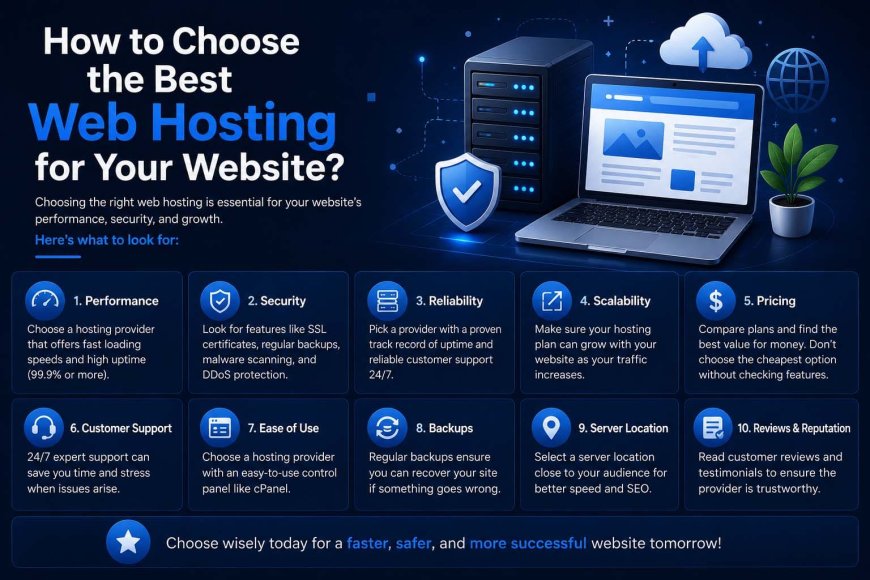
1. Hosting Speed and Server Performance
Hosting speed is one of the most important factors to consider when choosing a web hosting provider, as it directly affects website loading times and the overall user experience. The faster your pages load, the more likely visitors are to stay on your website and interact with its content. Fast loading speeds can also help reduce bounce rates and contribute to better website performance in search engine results.
Website speed is affected by several factors related to the hosting service, including the available server resources, CPU and RAM capacity, storage speed, bandwidth, and the geographical location of the server, which can affect the website’s response time for visitors.
Therefore, it is recommended to choose a web hosting provider that uses high-performance servers and offers fast storage technologies such as SSD or NVMe storage. Support for technologies such as a Content Delivery Network (CDN) can also help distribute website files across multiple servers and deliver content faster to users in different geographical locations.
Choosing a hosting service with strong performance does more than improve website speed. It can also provide a better browsing experience, increase visitor satisfaction, and support the long-term growth of your website.
2. Uptime Guarantee
Uptime refers to the percentage of time that your hosting server remains operational and accessible without interruption. It is one of the most important factors to consider when choosing a web hosting provider because it helps ensure that your website remains available to visitors at all times.
For this reason, it is recommended to choose a hosting provider that offers a high uptime guarantee. 99.9% uptime is a common standard offered by many hosting companies.
High uptime helps minimize website downtime, maintain visitor trust, and provide a consistent user experience. On the other hand, frequent outages can damage your website’s reputation, reduce traffic, and result in lost customers, especially for eCommerce stores and websites that depend on continuous availability.
When comparing hosting providers, it is also important to look beyond the advertised uptime percentage and review the provider’s uptime policy, service-level agreements, and track record.
3. Security and Protection
Website security is one of the most important factors to consider when choosing a web hosting service. It represents the first line of defense for protecting your website, maintaining its availability, and supporting its long-term success.
No matter how professional your website design is or how valuable your content may be, weak security can expose your website to hacking attempts and a wide range of cybersecurity threats.
Unprotected websites can face various risks, including Distributed Denial-of-Service (DDoS) attacks, malware, database attacks, and attempts to steal or expose user data. The consequences of these attacks are not limited to financial losses or temporary downtime. They can also damage your brand reputation and reduce customer trust.
Website security can also affect how users and search engines perceive your website. In particular, using HTTPS and providing a secure browsing experience are important aspects of running a trustworthy website.
Therefore, it is essential to choose a secure web hosting provider that offers strong protection measures, such as SSL/TLS certificates, regular backups, firewalls, malware protection, and threat monitoring tools.
Ultimately, choosing secure hosting should not be viewed as an unnecessary additional cost. It is an essential investment in protecting your website, maintaining its stability, and providing a reliable digital environment for your customers.
4. Customer Support
Customer support is another critical factor to consider before choosing a web hosting provider. Reliable technical support plays an important role in protecting your online business and ensuring that your website continues to operate smoothly.
A website is more than just a collection of files stored on a server. It is a system that requires ongoing management and may encounter software updates, cybersecurity threats, sudden increases in traffic, or unexpected technical errors.
In the online world, even a short period of downtime can affect your website’s reputation and customer trust and may result in lost opportunities, particularly for businesses that depend heavily on their online presence.
When a technical problem occurs, having a professional and responsive support team can help resolve the issue quickly and minimize its impact on your website.
24/7 customer support can be particularly valuable because it allows website owners to address technical problems whenever they occur instead of wasting valuable time trying to identify and resolve complex issues on their own.
Therefore, choosing a hosting provider with reliable and responsive technical support is essential for maintaining website security, stability, and availability.
5. Scalability
Scalability is an important factor to consider when choosing a hosting provider, especially for digital businesses that plan to grow and expand in the future.
When you first launch a website or online store, your resource requirements may be relatively limited. However, as your traffic increases, your content grows, or you add new products and services, you may need additional resources to maintain good performance.
For this reason, it is important to choose a hosting provider that allows you to upgrade your hosting resources easily and flexibly without requiring you to migrate your website to another server or experience extended downtime.
A scalable hosting solution allows your hosting environment to grow alongside your business, making it easier to handle increasing traffic and resource requirements without unnecessary technical complications.
6. Available Resources: Storage, RAM, and Processing Power
Reviewing the resources included in a hosting plan, such as storage space, RAM, and processing power, is one of the most important steps when choosing web hosting. These resources form the foundation that determines how effectively your website can operate.
Before entering your payment details and purchasing a hosting plan, it is important to understand that these resources are essentially the infrastructure of your digital home.
Choosing the right hosting resources ensures that your hosting plan matches the nature and requirements of your project. A simple blog, for example, may not require significant resources, while a large eCommerce store with databases, plugins, customer accounts, and multiple processes may require considerably more processing power and RAM.
Having sufficient resources helps prevent slow loading times and unexpected performance issues while maintaining stable website performance as traffic increases.
These resources are also closely connected to website speed, which can significantly influence whether visitors continue browsing your pages or leave because of poor performance. Website speed is also an important aspect of the overall user experience and can influence how effectively your website performs in search results.
7. Backups and Website Restoration
Backups and website restoration are among the most important features to consider when choosing a web hosting service. A reliable backup system is not simply an optional feature; it is an essential layer of protection against potential risks.
Whether you manage a small blog or a large eCommerce website, software errors, hacking attempts, accidental changes, and other unexpected problems can happen at any time.
Having an automatic and regular backup system, such as daily or weekly backups, provides greater peace of mind. It allows you to restore your website to a previous version when a problem occurs, helping you avoid permanently losing valuable content, files, databases, or years of work.
When choosing a hosting provider, always check whether backups are performed automatically, how frequently they are created, how long they are retained, and how easy they are to restore.
Ideally, website restoration should be available directly through the hosting control panel, allowing you to respond quickly to unexpected issues and maintain the continuity and security of your website.
8. Ease of Use and Website Management
Choosing a hosting provider with an intuitive interface and flexible control panel can make managing your website much easier, especially if you do not have advanced technical knowledge or a dedicated development team.
When starting your digital journey, you may discover that creating a website is only the beginning. The real challenges often involve everyday tasks such as creating a professional business email address, activating an SSL certificate, managing website files, connecting a domain, configuring backups, and monitoring your hosting resources.
If the hosting control panel is complicated and filled with unclear technical options, even simple tasks can become frustrating and time-consuming.
On the other hand, a hosting service with a clean and user-friendly interface gives you greater control and makes website management easier. It can allow you to install applications with a single click and manage important website settings without requiring advanced programming knowledge.
This allows you to focus more of your time on creating content, improving your website, and growing your business.
Why Do You Need Easy-to-Use Web Hosting?
- Easy website management and control panels: The control panel is your main interface for managing your hosting environment, including email accounts, website files, domains, databases, and other settings. A popular and user-friendly control panel such as cPanel or Plesk, or a simple custom control panel provided by the hosting company, can save you hours of troubleshooting and searching for solutions.
- One-click installation: A one-click installer allows you to install content management systems such as WordPress and eCommerce platforms within minutes, without having to write or configure complex code manually.
- Saving time and effort: When domain management, SSL certificates, backups, and other essential tools are available through a clear and intuitive interface, you can complete administrative tasks more efficiently and spend more time developing your website and growing your business.
9. Price and Value for Money
The cost of web hosting and the overall value for money are important considerations that should not be overlooked. Hosting costs can directly affect the financial sustainability of your website or online business.
When searching for a hosting service, you will find significant differences in pricing. Some companies offer very low-cost plans, while others charge considerably more for their services.
However, it is important to avoid the trap of choosing a hosting provider solely because it offers the lowest price. Extremely cheap hosting plans may sometimes come with limitations such as poor performance, frequent downtime, limited customer support, restricted resources, or unclear renewal policies.
Some providers may also offer a very low introductory price and then significantly increase the price when the plan is renewed.
At the same time, paying more does not automatically mean you are getting a better hosting solution. Higher-priced hosting is only worthwhile when the additional resources, features, performance, and support actually meet your website’s needs.
Therefore, the right choice should be based on value for money, rather than price alone. Compare your website’s requirements with the resources, features, performance, security, support, and scalability offered by each hosting provider.
The ideal hosting cost is one that provides reliable performance, strong security, responsive customer support, and sufficient resources for your website to grow, without creating an unnecessary financial burden for your business.
Conclusion
In this guide, we have explained what web hosting is, explored the different types of web hosting, and discussed the most important factors to consider when choosing the right hosting service for your website.
Ultimately, choosing the right web hosting service is not simply about finding the lowest price. It is about finding a hosting solution that matches your website’s needs in terms of performance, security, ease of management, reliability, and future scalability.
Choosing the right hosting provider from the beginning can help you build a fast, secure, and stable website while avoiding many technical problems and unnecessary costs in the future.
A well-chosen hosting service provides a strong foundation for your website and gives your online business the stability and flexibility it needs to grow and succeed in the digital world.