





What Are E-Commerce Platforms?
An e-commerce platform is a software system or application that allows businesses and individuals to create and manage an online store without requiring advanced programming knowledge. This platform serves as the core tool through which full control over the online store is achieved, whether regarding content, products, orders, or the overall user experience.
An e-commerce platform functions as an integrated environment for managing the website, enabling users to create, edit, organize, store, and publish content for customers easily, with the ability to modify or delete it at any time. This is achieved through a simple control panel that, in most cases, does not require the help of a web developer.
The role of an e-commerce platform is not limited to simply displaying products. It provides a comprehensive set of tools that help manage the entire business, such as:
- Product and Inventory Management: The platform helps you manage inventory and accurately track available product quantities, from purchasing products from suppliers and storing them in warehouses to delivering them to customers. The platform acts as a precise monitor of your warehouse, updating stock levels in real-time. Once a customer purchases a product, inventory automatically decreases in the system. It also allows managing SKUs by assigning a unique code to each product to facilitate tracking, and supports multiple warehouses, enabling inventory management across locations (e.g., a warehouse in Riyadh and another in Jeddah). Additionally, the platform can automatically hide products when they are out of stock or display a message like “Out of Stock.”
- Order Processing and Invoicing: Order and invoice management forms the backbone of the online store. The platform helps connect the customer’s payment with the delivery process via an automated system that minimizes human error.
The process begins with receiving the order and automatically updating its status, followed by preparing the order and issuing a shipping label. Next, the order is shipped, with a tracking link sent to the customer, and it ends upon delivery completion.
For invoicing, the platform allows generating automatic digital invoices that comply with tax regulations, sending them to the customer, and archiving them in an organized manner for easy retrieval or export for accounting purposes. - Accounting Systems and Financial Reports: An e-commerce platform provides integrated accounting systems and financial reports, giving the merchant a clear overview of the store’s performance, such as sales and revenue reports, tax reports with automatic VAT calculations, payment method analysis, and profit calculations in some platforms after entering the product cost.
It also enables smooth integration with professional accounting systems like Qoyod, Foodics, Xero, and QuickBooks, allowing sales data to transfer automatically, generating accounting entries, and updating reports without manual intervention. - Digital Marketing Tools: E-commerce platforms offer digital marketing tools designed to increase traffic and sales, such as discount coupons, promotional campaigns, loyalty programs, automated email marketing, and social media integrations with campaign tracking. They also integrate with advertising platforms like Google Ads and Meta. While the platform provides the tools, campaign management and ad budgets remain the merchant’s responsibility.
- Payment Gateway Integration: E-commerce platforms integrate with payment gateways to facilitate secure and flexible online payment acceptance. Typically, platforms support a range of local and international payment methods, such as credit/debit cards (Visa/Mastercard), Apple Pay, Google Pay, as well as cash on delivery and installment options.
This integration includes technical linking within the platform, transaction processing, and data security, allowing merchants to accept payments directly without having to build a payment system from scratch. - Shipping and Delivery Management: Shipping and delivery management is the “third corner” of the e-commerce triangle (product, payment, shipping), and the platform professionally handles this aspect, eliminating the need for manual coordination with shipping companies.
The platform provides ready partnerships with local and international shipping companies, which can be activated directly from the control panel. It allows defining shipping costs based on weight, destination, or order value, supports multiple shipping options, automatically generates shipping labels, updates order statuses, and sends tracking links to customers—streamlining the entire shipping process from start to finish.
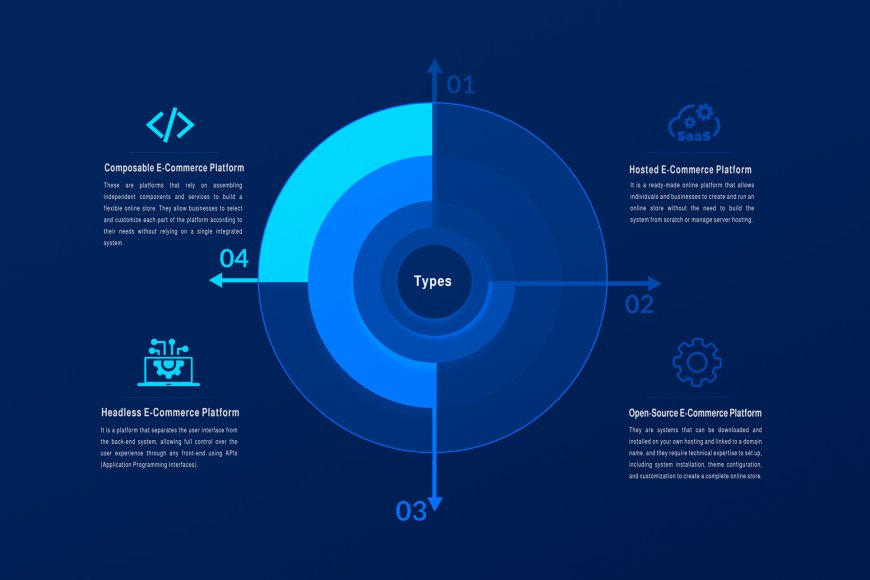
Types of E-Commerce Platforms
1. Hosted E-Commerce Platforms (SaaS)
Hosted platforms, also known as SaaS (Software as a Service) platforms, are ready-to-use systems offered as an online service. They allow you to create and manage your online store without the need for hosting, programming, or technical maintenance. Essentially, it is a pre-built store that you rent for a monthly subscription, where the service provider handles all technical aspects such as hosting, security, and regular updates on your behalf.
The main advantages of SaaS platforms include ease and speed of launch, as they require no programming experience. Stores can often be created using drag-and-drop visual interfaces.
Hosting is built into the service, which eliminates the need to find a separate hosting provider or worry about server downtime during high traffic. Additionally, these platforms provide a high level of security, taking responsibility for protecting payment data and providing SSL certificates. They also offer dedicated technical support to resolve issues when needed, and automatic updates that improve the system and add new features without any intervention from you.
Popular Hosted E-Commerce Platforms (SaaS):
- Shopify: Shopify is a globally recognized hosted e-commerce platform that enables individuals and businesses to create and manage online stores easily without technical or programming knowledge. It provides a complete suite of tools covering product and order management, payment systems, shipping, marketing, and financial reporting, with integrated hosting, high security, and continuous automatic updates.
Shopify is considered the leading global platform for hosted e-commerce, offering a comprehensive solution that allows any user to launch a professional online store and operate it entirely without building the website from scratch. Instead of worrying about technical aspects like servers, coding, or maintenance, Shopify provides ready infrastructure, including hosting, security, and essential software, all for a fixed monthly subscription. - BigCommerce: BigCommerce is another hosted SaaS e-commerce platform that allows individuals and businesses to create and manage professional online stores without programming or dealing with technical complexities. It offers advanced tools for product and order management, payment systems, shipping, and reporting, with a focus on high performance and scalability.
BigCommerce is ideal for medium and large stores, supporting multi-channel sales across online stores, global marketplaces, and social media platforms. It integrates smoothly with many payment gateways, shipping solutions, and marketing tools, and operates on a subscription model that includes hosting, security, and regular updates. - Wix eCommerce: Wix eCommerce is an e-commerce solution integrated into the Wix platform, allowing users to create online stores using a drag-and-drop visual editor without technical knowledge. The platform enables selling physical and digital products, managing orders, payments, and shipping from a single control panel.
It provides essential e-commerce tools such as product and inventory management, payment gateway integration, shipping and tax settings, and basic marketing tools. Wix eCommerce is particularly suitable for small projects and startups seeking a fast and easy-to-launch solution. Compared to Shopify (specialized for intensive selling) and BigCommerce (focused on larger stores), Wix emphasizes design and ease of use. - Squarespace Commerce: Squarespace Commerce is an e-commerce service integrated into Squarespace, allowing users to create a professional online store without technical knowledge. It focuses on balancing visual appeal with ease of management, making it ideal for creative brands and small businesses prioritizing aesthetics.
Squarespace provides essential tools for managing products, orders, payments, shipping, and taxes, along with basic marketing tools and integration with different payment gateways.
2. Open-Source E-Commerce Platforms
Open-source e-commerce platforms are systems that can be downloaded and installed on your own hosting, connected to a domain, and require technical expertise for setup, including system installation, theme configuration, and full customization to create a complete online store.
Unlike ready-made SaaS platforms, which are pre-built and managed by the provider, open-source platforms require technical skills to set up the store, connect it to essential services such as payment gateways and shipping, and troubleshoot any technical issues. Typically, there is no direct technical support team, but you can rely on technical websites, forums, and user communities for guidance.
Open-source platforms may not be ideal for beginners or those starting without prior experience in content management systems such as Magento, WordPress, or OpenCart. Store management, including handling orders and basic functions, is relatively straightforward, but building the store, installing it on hosting, customizing it, and integrating payment gateways often requires a specialized web developer.
Popular Open-Source E-Commerce Platforms:
- WooCommerce: WooCommerce is an open-source e-commerce platform that works as a plugin on WordPress, transforming any WordPress website into a fully functional online store. It allows product and inventory management, order processing, payments, shipping, and taxes, with high flexibility thanks to multiple themes and plugins.
WooCommerce is ideal for small to medium stores but requires private hosting and technical management for updates and security. A major advantage is full ownership—unlike SaaS platforms, you own your store completely, can move data to another hosting service, and have unlimited customization via code. WooCommerce also integrates widely with almost all local and international payment gateways. - Magento (Adobe Commerce): Magento is a robust open-source platform used to create advanced and scalable online stores. It offers high flexibility and powerful capabilities for product, order, customer, promotional, and reporting management, making it suitable for medium to large stores with complex operations.
Magento is often referred to as the “ideal choice for large enterprises.” While WooCommerce serves small and medium stores, Magento is selected by companies managing millions of products requiring advanced customization. It can handle high traffic and hundreds of thousands of products without performance degradation, provided a strong server is used. - PrestaShop: PrestaShop is an open-source e-commerce platform that enables creating and managing online stores with wide customization via themes and modules. It provides tools for product and inventory management, order handling, payments, shipping, taxes, and detailed performance reports.
PrestaShop is suitable for small and medium stores and is easier to use compared to some other open-source platforms. However, it requires dedicated hosting and technical management for installation and security.
OpenCart: OpenCart is an open-source e-commerce platform known for ease of use and lightweight performance. It offers product and inventory management, order processing, payments, shipping, taxes, and supports themes and extensions for customization.
OpenCart is ideal for small and medium stores but requires private hosting and technical management. It is widely known for being fast and efficient even on basic hosting environments, making it an economical solution for building an online store with excellent performance.
3. Headless Commerce Platforms
Headless commerce platforms are an advanced type of e-commerce system that separates the front-end (the store interface) from the back-end (content and product management). This allows each part to operate independently. The core idea is that the front-end can be built using any technology such as React, Angular, or Vue.js, while the back-end manages products, orders, payments, inventory, and shipping, accessed through APIs.
This type of platform requires strong programming expertise and is typically designed for large companies with professional development teams looking to build a fully customized online store from scratch. It is not recommended for beginners or those with limited budgets, due to its high cost and need for continuous development and maintenance.
Popular Headless Commerce Platforms:
- Commercetools: Globally leading, fully designed as a headless platform.
- Shopify Plus (Headless): Uses Shopify’s back-end while allowing a completely custom front-end built in frameworks like React.
- BigCommerce (Headless): Provides developers with powerful tools to separate the front-end from the system.
- Adobe Commerce (Magento): Supports headless architecture for large enterprises requiring maximum flexibility.
4. Composable Commerce Platforms
Composable Commerce refers to modular or assemble-your-own e-commerce systems. The idea behind these platforms is to allow companies to build their e-commerce system by selecting and combining the best services and tools, rather than relying on a single all-in-one platform. Think of it like Lego blocks: you choose components (product management, payment, marketing, customer management) and assemble them to create your own system.
If traditional platforms like Shopify are a “ready-made meal,” Composable Commerce is like a “buffet” where you carefully select each ingredient.
Difference Between Traditional Platforms and Composable Commerce:
In traditional platforms such as Shopify or Magento, everything is handled within a single, integrated platform. In Composable Commerce, each function is separated, and the best provider can be chosen for each function. For example: Commercetools for product and order management, Stripe for payment gateways, Algolia for fast product search, and Mailchimp for email marketing. In this way, you have an e-commerce system designed specifically according to your needs, rather than just a ready-made platform trying to do everything.
Conclusion: Composable Commerce is a strategy for building an online store by assembling the best available software services and connecting them together, instead of relying on a single platform that may not perform all functions equally well. It is not recommended for beginners or for small or new e-commerce stores, as it requires strong technical expertise and a specialized team to set up and operate the system. Everything depends on selecting and integrating the services (APIs), rather than just pressing buttons; you will need to work with APIs, integrate systems such as payments, inventory, and search, connect the front-end with the back-end, and also manage hosting and maintenance.
Additionally, costs are usually higher than ready-made platforms because they include subscription fees for each service you choose (such as Commercetools, Stripe, Algolia), hosting costs, website/app development costs, and sometimes the cost of a technical team if you lack programming expertise. Unlike platforms such as Shopify or WooCommerce, where you can start with relatively small amounts and minimal technical knowledge.
5. Custom-Built Platforms
Custom-built e-commerce platforms are developed and programmed from scratch without relying on any ready-made system such as Shopify or WordPress. Simply put, you hire a team of developers to write every line of code in the store according to your specific requirements, much like building a custom-designed house instead of buying a ready-made apartment.
These platforms are built precisely according to the project’s needs, without using pre-designed templates, so that everything is fully customized, including the website design, product management, payment systems, inventory, and user experience. They are usually developed using programming languages and frameworks such as PHP with Laravel or JavaScript with technologies like Node.js and React.
This type of platform is not recommended for beginners, as it is suitable for large companies or stores that have complex requirements that cannot be met by ready-made platforms. Small stores or startups are better off starting with ready-made platforms such as Shopify or WooCommerce, then moving to a custom-built platform later as the business expands.
This option also comes with several challenges, the most prominent of which is the high cost, as it requires a significant budget to cover the expenses of developers, designers, and security experts. Costs can reach tens or even hundreds of thousands of dollars. Additionally, the implementation process takes a long time, as building a store from scratch can take six months to a full year, compared to ready-made platforms that can be launched within days. Furthermore, ongoing maintenance is required, as any technical issue—even minor—will require a developer to resolve it; there is no technical support from a company like Shopify to handle it for you.
In Conclusion
There is no single e-commerce platform that is the best choice for everyone. Choosing the right platform primarily depends on the size of the project, the available budget, the level of technical expertise, and future expansion plans. Hosted platforms (SaaS) are an ideal option for beginners and small businesses, while open-source platforms offer greater control and flexibility for those with technical knowledge. Headless solutions, Composable Commerce, and custom-built platforms, on the other hand, are designed for large companies that require high performance, a customized user experience, and advanced technical infrastructure.
Therefore, before deciding on an e-commerce platform, it is important to carefully evaluate your current and future project needs, balancing ease of use with flexibility and cost, to ensure the creation of an online store that can grow and remain sustainable in the long term.